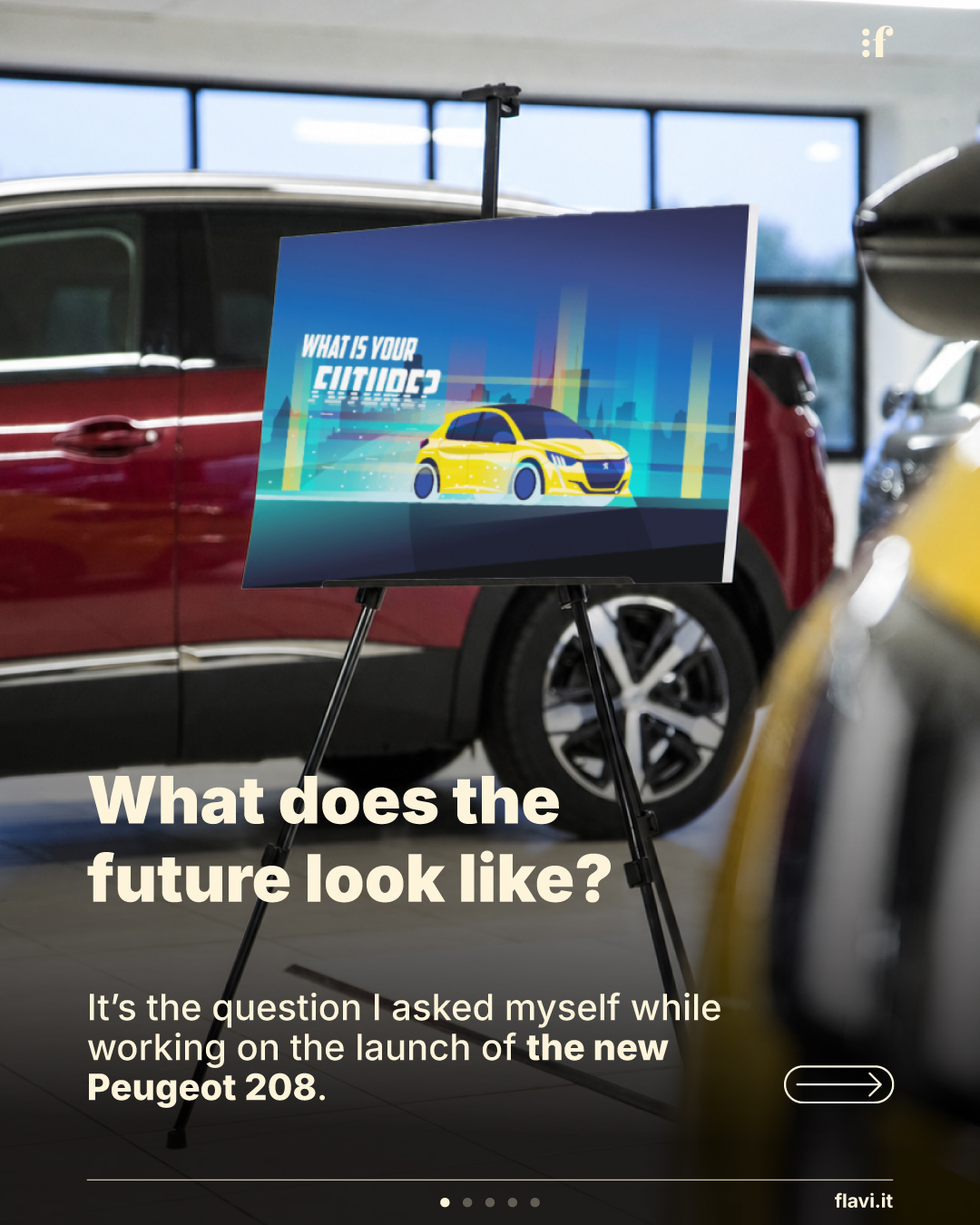
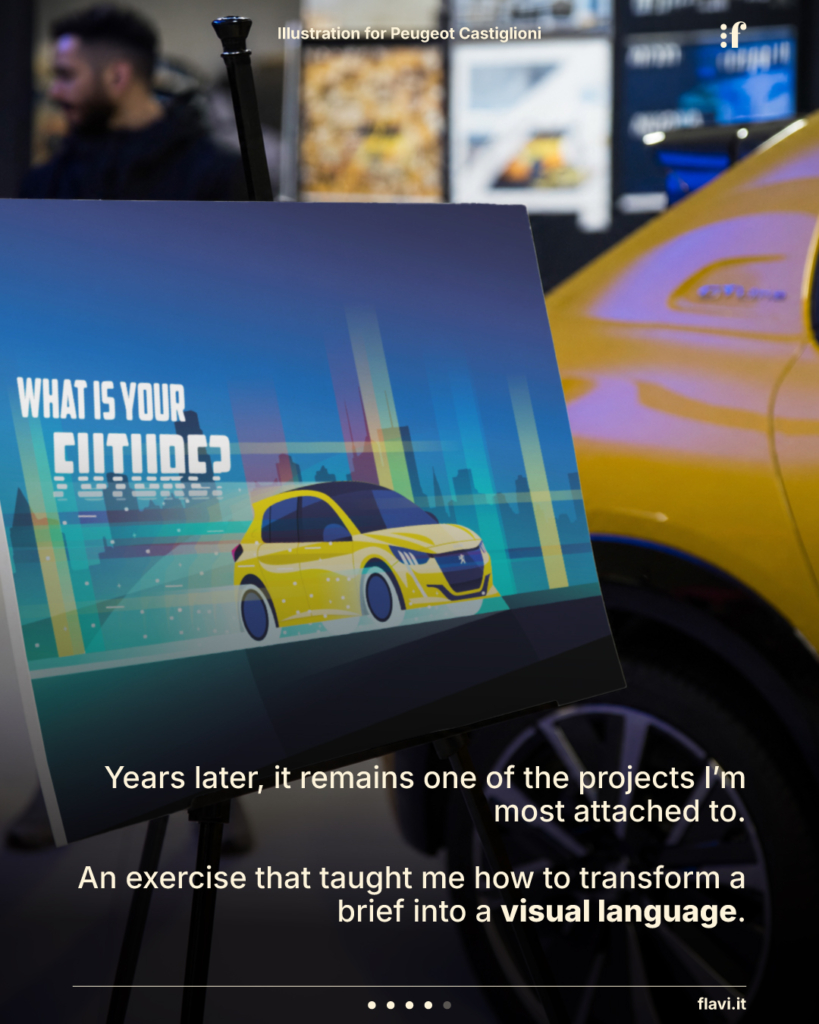
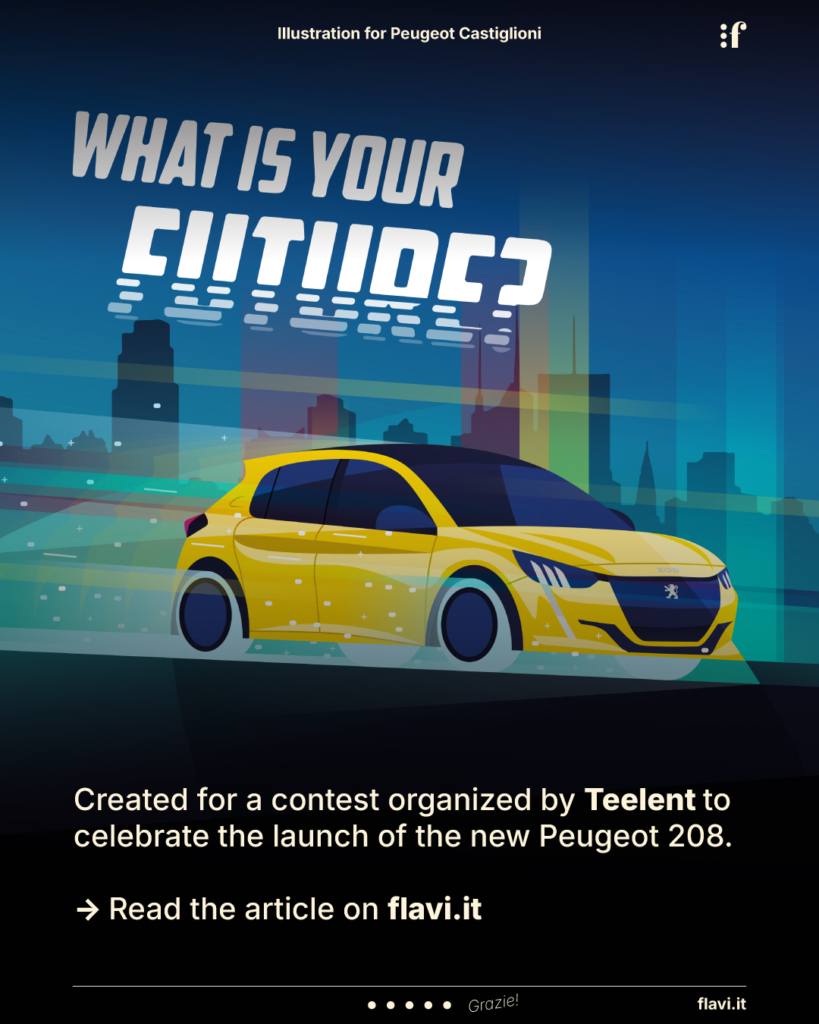
In 2019, I created this illustration for a contest organized by Teelent on behalf of Peugeot Castiglioni in Varese.
Teelent is an Italian platform that connects companies with creative professionals through design competitions. Brands publish a brief, the community develops proposals, and a jury selects the strongest concepts. It’s an engaging way to work on real-world assignments and challenge yourself with genuine communication projects.
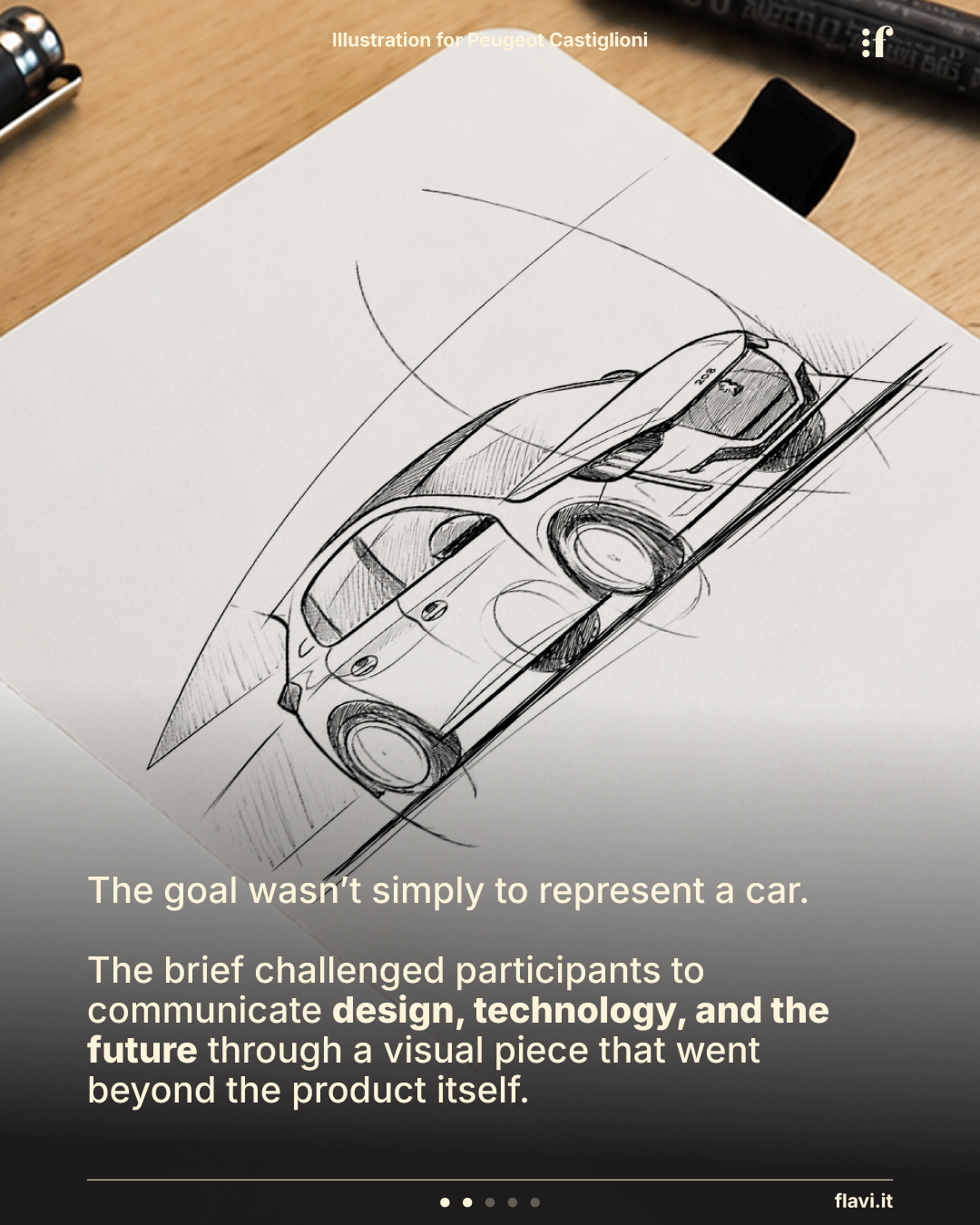
In this case, the brief accompanied the launch of the new Peugeot 208. Built around the claim “What Is Your Future?”, participants were invited to transform the car into a visual piece capable of communicating its design, technology, and vision of the future, with complete freedom in terms of artistic style and technique.
My interpretation
The question I asked myself was simple: What does the future look like?
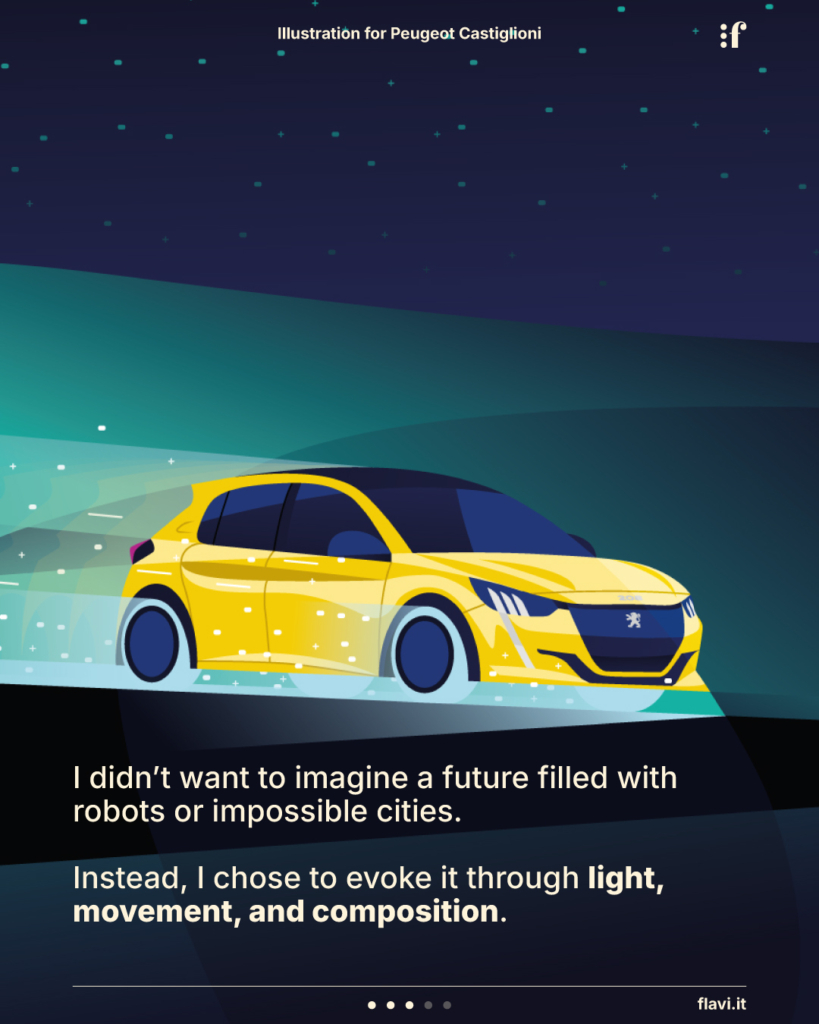
I didn’t want to portray a science-fiction future filled with robots or impossible cities. Instead, I was interested in conveying a feeling rather than illustrating a specific vision of tomorrow.
With that in mind, I imagined the Peugeot 208 within a minimal urban environment, crossed by beams of light, luminous trails, and geometric forms. These elements aren’t meant to represent real buildings, but rather to evoke energy, connection, and movement.
The car remains the focal point of the illustration. Its yellow body stands out against a cool palette of blues and cyans, while the perspective lines naturally guide the viewer’s eye toward the vehicle, emphasizing its shape and character.
The deliberately digital and dynamic style was chosen with a clear purpose: to communicate innovation without relying on the usual visual clichés associated with “the future.”
A project I still enjoy looking back on
The illustration wasn’t selected in the contest.
Even so, years later it remains one of the projects I’m most attached to.
It challenged me to interpret a brief, distill a message, and translate abstract concepts such as the future, technology, and design into a single image.
Looking at it today, I still consider it one of the most rewarding illustration and visual communication exercises I’ve ever created.